

 See My Latest Article on HelloNation
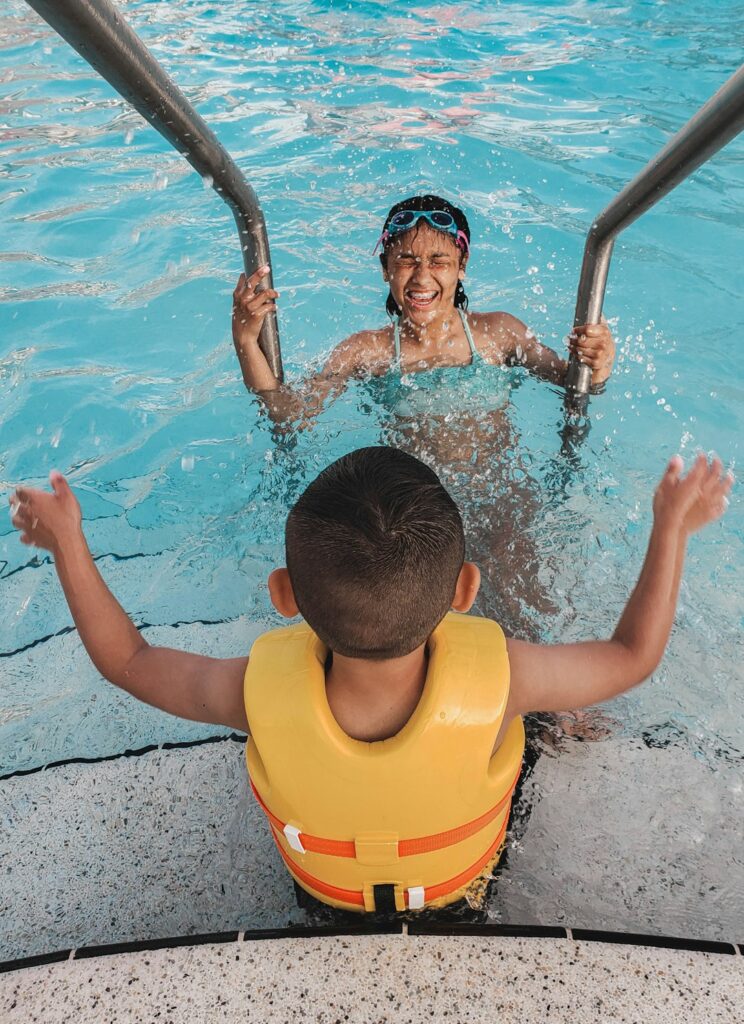
Children in Roswell, GA often spend more time around water during warm, humid summers, whether at a backyard pool, a neighborhood gathering, or a family recreation setting. Confidence in the pool does not mean a child is fearless. It means the child can respond calmly, follow directions, try age-appropriate skills, and seek help when needed.
Confidence develops gradually through safe repetition, supportive adults, and realistic expectations. The goal is not to rush a child into deep water or make swimming feel like a test. The goal is to help the child become comfortable, capable, and aware of personal limits.
What does pool confidence actually mean?
Pool confidence is a child’s ability to participate safely without becoming overwhelmed. A confident swimmer may still pause before entering unfamiliar water or ask an adult to stay nearby.
Signs of developing confidence can include:
- Entering the water calmly with adult support
- Blowing bubbles or putting the face near the water
- Holding the wall and moving along it
- Floating with assistance
- Returning to a standing position
- Following simple pool rules
- Asking for help when tired, cold, or unsure
Confidence should not be judged by how quickly a child swims across a pool. A child who understands limits and responds to instructions may be showing stronger safety awareness than a child who jumps in without hesitation.
How can parents make the first experiences positive?
Start with predictable, low-pressure activities. Children usually respond better when they know what will happen and can stop before becoming distressed.
A first visit might involve sitting near the edge, watching others, touching the water with the feet, or practicing gentle splashing. An adult can describe each step before it happens: “First we will sit on the step, then we will pour water over your hands.”
Avoid using surprise submersion, forced jumps, or teasing language. These approaches may create fear and make a child less willing to participate in future swim lessons or family pool time.
Keep early sessions short. Ten calm minutes can be more productive than a long visit that ends with exhaustion or tears. Finish with a familiar activity, such as playing on the steps or practicing safe exits.
What should a swim instructor teach before advanced swimming?
A qualified swim instructor should help children develop foundational safety skills before focusing on distance or speed. These skills may include:
- Safe entry and exit
- Breath control
- Floating on the front and back
- Rolling from the front to the back
- Moving toward the wall
- Turning around in the water
- Climbing out at the pool edge
- Listening for and following safety directions
For young children, toddler swim lessons and baby swim lessons often focus on comfort, caregiver participation, body positioning, and basic water safety. These classes do not make a child “drown-proof,” and an adult must remain within immediate reach of a young or inexperienced swimmer.
Older children may benefit from swim classes that combine skill practice with supervised games. Play can reduce pressure while still reinforcing important movements, such as kicking, reaching, floating, and changing direction.
How should adults respond when a child is afraid?
Fear should be acknowledged without allowing it to control every interaction with the water. A calm response might be, “The water feels unfamiliar. We can stay on the steps and practice together.”
Avoid telling a frightened child that there is nothing to fear. The child’s reaction is real, even if the activity appears safe to an adult. Instead, reduce the challenge and offer a manageable choice:
- Sit on the steps or stand beside the pool
- Hold an adult’s hand or the wall
- Practice bubbles or kicking
- Watch another child demonstrate
- Try again later
Some children need several visits before they are ready to put their face in the water. Progress may be uneven, especially after a frightening experience, illness, a long break, or a change in pool environment.
Should parents choose group or private swim lessons?

Both group and private swim lessons can support confidence, but the better choice depends on the child’s personality, experience, and learning needs.
Group lessons can help children see peers practicing similar skills. This may make the class feel social and predictable. They also give children opportunities to take turns and follow directions around others.
Private swim lessons provide more individualized attention and may be useful when a child is especially cautious, easily distracted, or working on a specific skill. A private setting can also allow the instructor to adjust the pace more precisely.
The most important factors are age-appropriate teaching, close supervision, clear instruction, and a pace that challenges the child without creating panic. Families should not assume that a more advanced class will automatically build confidence. A poor skill match can have the opposite effect.
How often should children practice?
Regular, brief practice is generally more useful than occasional long sessions. Families can reinforce skills during supervised pool time without turning every visit into a formal lesson.
A simple practice routine might include:
1. Safe entry with an adult nearby
2. Five bubble breaths
3. Holding the wall and moving a short distance
4. Floating with support
5. Rolling to the back
6. Returning to the wall or exit
Practice should stop when the child becomes overly tired, cold, frustrated, or unable to follow directions. Fatigue affects judgment and coordination, so a child who swims well early in a session may need much more support later.
In the warm-weather months, households with pools may have more opportunities to practice. That access should not reduce supervision. A child who appears comfortable in shallow water can still face danger near steps, drains, drop-offs, ladders, and unfamiliar pool layouts.
What safety habits support confidence outside lessons?
Confidence grows more safely when children learn that pool rules apply every time. Adults should establish clear expectations before entering the water.
Useful household rules include:
- An adult watches from the pool area, not from inside the home
- Children ask permission before entering
- Running, pushing, and rough play are not allowed
- Children stay within the area that matches their skill level
- Life jackets are used for boating or open-water activities when appropriate
- Breaks are taken for water, shade, food, and rest
- Children tell an adult when they feel tired or uncomfortable
Constant supervision remains necessary even after formal swimming lessons. Lessons teach skills; they do not replace active supervision, barriers, emergency preparation, or appropriate flotation equipment.
Families with backyard pools should also consider secure barriers, self-closing and self-latching gates, and keeping toys out of the water when the pool is not in use. These steps reduce the chance that a child will enter unnoticed.
What if a child says, “I can’t swim”?
Respond with encouragement that is specific rather than exaggerated. Instead of saying, “You are a great swimmer,” describe what the child actually did: “You held the wall, turned onto your back, and listened when it was time to stop.”
Avoid comparing siblings or classmates. Children develop water skills at different rates, and confidence can be affected by temperament, sensory sensitivity, previous experiences, and comfort with instruction.
A child who continues to panic, avoids all water contact, or cannot recover after a frightening event may need a slower teaching approach. The priority is to rebuild trust through small, successful steps rather than forcing progress.
With consistent supervision, suitable swim lessons, and calm practice, children can learn to approach the pool with greater awareness and control. Confidence is built through repeated experiences in which the child feels safe, understands the next step, and knows a trusted adult is paying attention.